Leaking During Your Workout? Why “Just Do Kegels” Isn’t the Answer for Athletes
Leaking during CrossFit, running, or lifting? Athletic incontinence is common but not normal. Discover how holistic Pelvic Floor OT helps you train leak-free.
You Aren’t Broken (And You Aren’t Alone)
You’re in the middle of a heavy deadlift, or maybe you’re hitting the pavement for your weekend long run, and suddenly, you feel it. A small, unexpected leak.
If this has happened to you, please take a deep breath and know this: you are not broken. It’s incredibly common for athletes—from recreational runners to competitive weightlifters—to experience leakage during high-impact or heavy-lifting activities.
But while it might be common, it isn’t something you just have to “live with” or manage with panty liners forever. Your body is communicating with you, and together, we can decode what it’s trying to say.
The Myth of the “Weak” Pelvic Floor
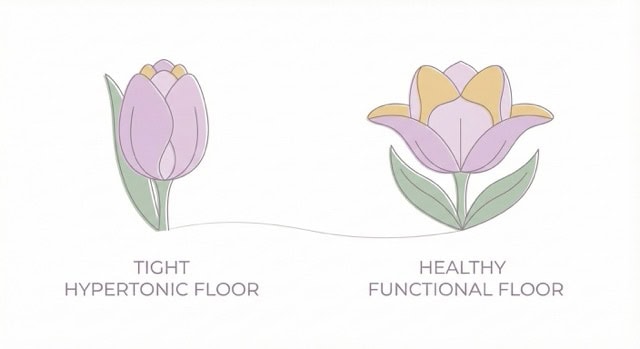
If you’ve ever mentioned workout-induced leakage to a friend, you were probably told to “just do more Kegels.” But here is a critical truth from an Occupational Therapy perspective: for many athletes, your pelvic floor isn’t weak; it’s overworked and tight.
Athletes are incredibly skilled at generating tension to produce force. However, if your pelvic floor muscles are constantly clenched, they lose their full range of motion. Imagine trying to do a bicep curl when your arm is already bent as tight as it can go—you wouldn’t have any power left!
When your pelvic floor is in this constant state of high tension, it simply doesn’t have the “give and take” required to catch the sudden downward pressure of a heavy squat or a box jump.
The Missing Link: Your Nervous System and Whole-Body Mechanics
Your pelvic floor doesn’t exist in a vacuum. It is deeply connected to your central nervous system, your diaphragm, and how you manage pressure throughout your entire body.
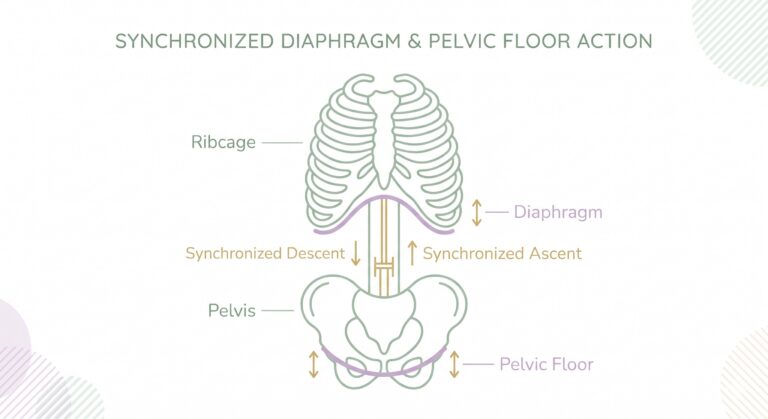
When you push your body hard in a workout, your nervous system can shift into a sympathetic “fight or flight” state. This heightened state often causes shallow, chest-dominant breathing. When your breathing mechanics change, the natural, piston-like coordination between your diaphragm (your breathing muscle) and your pelvic floor is disrupted.
Instead of spreading intra-abdominal pressure evenly, all that force gets aimed directly downward. To heal athletic leakage, we have to look at the whole picture: how your nervous system handles stress, how your ribcage expands, and how your breath guides your core.

The OC Pelvic Wellness Difference
In traditional, insurance-based healthcare models, you might get 15 rushed minutes with a provider who hands you a generic sheet of exercises. That “assembly line” approach simply doesn’t work for resolving complex athletic symptoms.
At OC Pelvic Wellness, we do things differently. You receive unhurried, 60-minute, one-on-one sessions tailored entirely to your unique biomechanics and lifestyle. We have the time to analyze your lifting form, assess your breathing, and calm your nervous system.
And because we know that many of our athletes are also navigating the postpartum chapter, your baby is always welcome to join us. You shouldn’t have to choose between getting premium, holistic care and managing childcare.
Ready to Train With Confidence?
You deserve to run your miles, and enjoy your movement without fear of leaking.
If you are ready to move beyond generic advice and get to the root cause of your symptoms, I am here to help. Book your comprehensive 60-minute evaluation with Lacey today, and let’s get you back to the activities you love—safely, strongly, and confidently.
You deserve care that looks at the whole picture—your muscles, your nervous system, and your life.

Disclaimer: The information in this post is for educational and informational purposes only and does not constitute specific medical advice. Always consult with a qualified healthcare professional before beginning any new treatment or exercise program.